
When people ask me where to practise for the CCAT, they’ve usually tried a couple of free tests already and hit the same wall: half of them are ten questions and a sign-up form, and one of the top Google results is a practice test for the Canadian school test that shares the name. These are the six I’d actually use, what each one gives you, and how to get real value from a practice test once you’ve picked one.
The short answer: my top pick is PrepClubs, because it’s the most complete prep option, with 14 full-length mocks on the real timer. For free practice alongside it, JobTestPrep’s full 50-question simulation and Criteria’s own sample questions are the two I’d do first.
On this page
Quick reminder: what the CCAT is
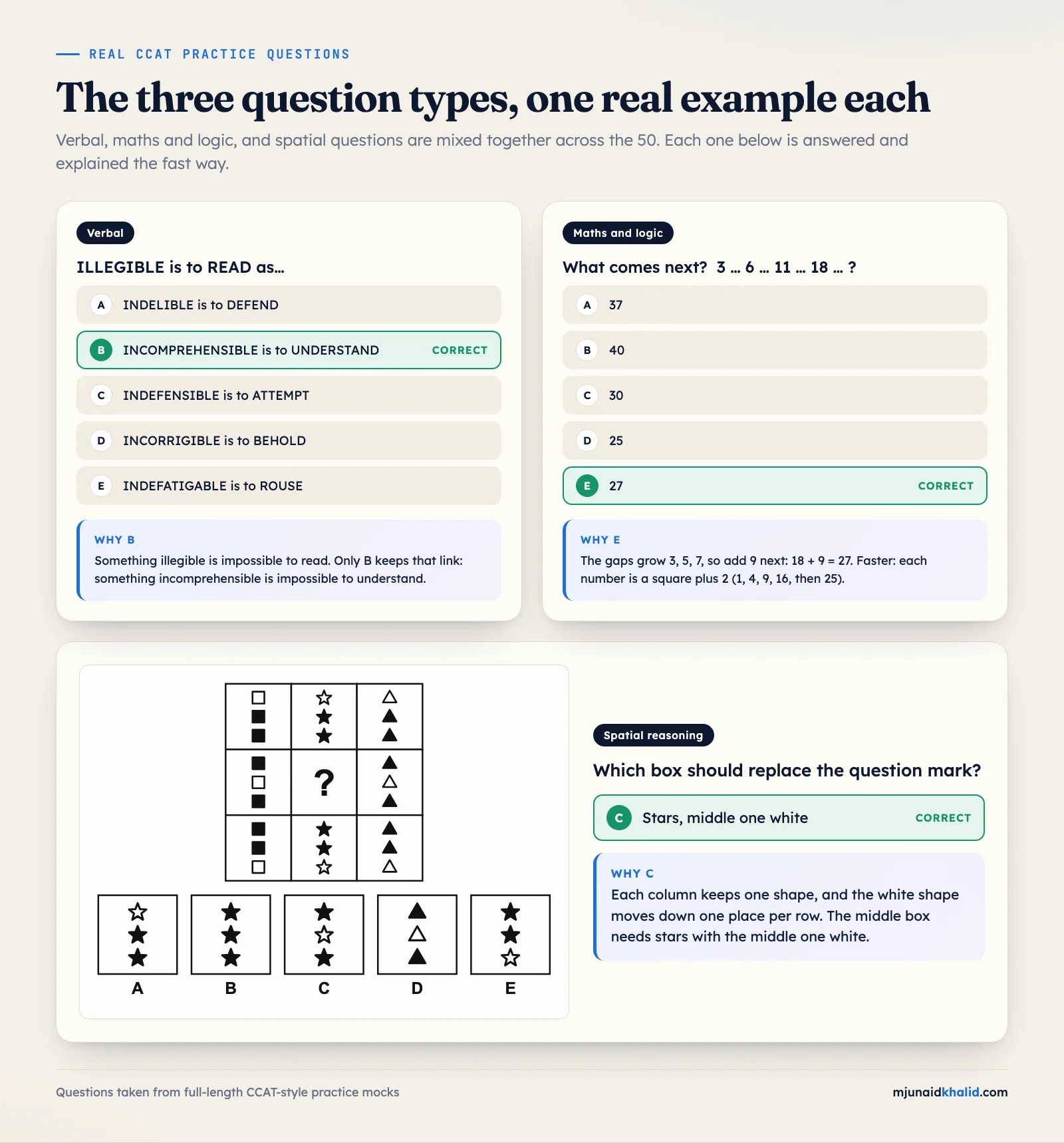
The Criteria Cognitive Aptitude Test is a pre-employment test: 50 questions on verbal reasoning, maths and logic, and spatial reasoning, in 15 minutes. That’s 18 seconds a question, and the clock is the whole difficulty. Almost nobody finishes, and the average score is about 24 out of 50.
That’s why the single most important thing about a practice test is whether it copies the timing. A practice test with untimed questions teaches you the question types. Only a full 50-question, 15-minute run teaches you the pace, and the pace is where most points are lost.
The 6 resources compared
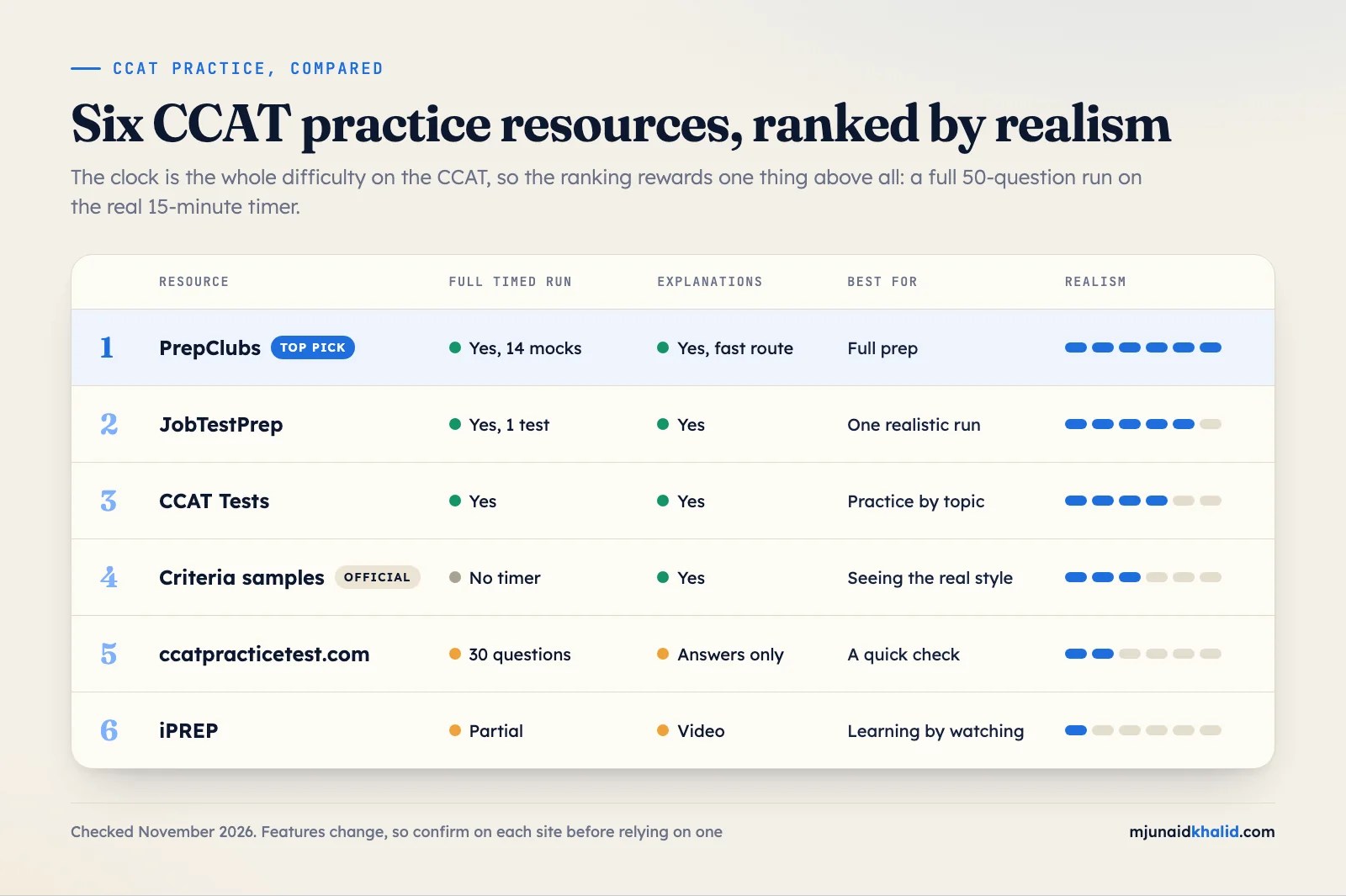
I’ve ranked these by how close each one gets you to the real test.
| Resource | Full timed test | Explanations | Best for |
|---|---|---|---|
| 1. PrepClubs | Yes, 14 mocks | Yes, fast route | Full prep |
| 2. JobTestPrep | Yes, 1 | Yes | One realistic run |
| 3. CCAT Tests | Yes | Yes | Practice by topic |
| 4. Criteria samples | No | Yes | Seeing the real style |
| 5. ccatpracticetest.com | 30 questions | Answers | A quick check |
| 6. iPREP | Partial | Video | Learning by watching |
1. PrepClubs (top pick)
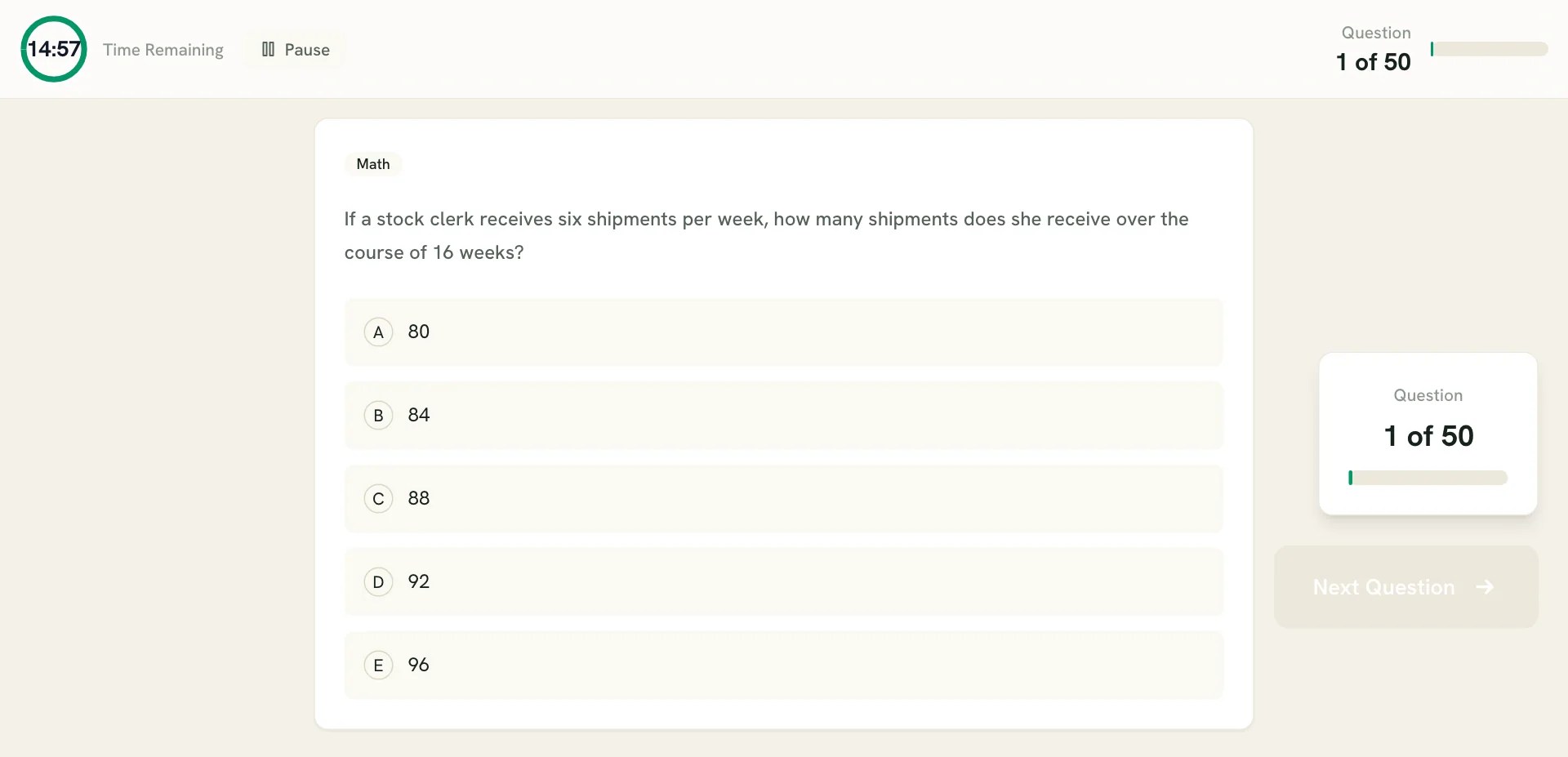
What you get: 1,350+ CCAT questions, organised as 14 full-length mocks and 12 topic drills across verbal, maths and logic, and spatial reasoning. Every mock runs on the real 50-question, 15-minute timer. There’s also a 7-lesson interactive course on the fastest way to answer each question type, and the explanations show the quick route to the answer rather than the long textbook method.
Why it’s first: it’s the only option here deep enough to cover a full week of preparation without repeating questions. You can take a mock, see which question type cost you the most time, drill that type, then take another mock. That loop is how scores actually move.
Watch out for: it’s built for people who are serious about the test. If you only want a feel for the format, a single free run from the list below will do.
See the CCAT mocks and drills on PrepClubs
2. JobTestPrep
What you get: a free full-length simulation, 50 questions in 15 minutes, plus sample questions broken down by type on the same page.
Why it’s here: it’s one of the few free options that copies both the length and the timer, which makes it a good baseline test. Take it cold on day one so you know where you’re starting from.
Watch out for: it’s one test. Once you’ve taken it you can’t use it as a clean benchmark again, so save it for a moment when the score matters to you.
3. CCAT Tests
What you get: a 50-question, 15-minute practice test you can start without signing up, practice questions sorted by category with explanations, a new question every day and a raw-score-to-percentile calculator.
Why it’s here: the category view is the useful part. If your baseline showed you’re losing time on spatial questions, you can work through only those.
Watch out for: topic practice builds accuracy, but it won’t build pace on its own. Pair it with full timed runs.
4. Criteria’s official sample questions
What you get: sample verbal, maths and spatial questions with answers and explanations, published by Criteria Corp, the company that makes the CCAT, plus a short overview of what to expect on test day.
Why it’s here: it’s the only source on this list written by the test maker, so it’s the best way to see the real question style and wording before you start practising elsewhere.
Watch out for: there are only a handful of questions and no timer. Read it once, then move on to timed practice.
5. ccatpracticetest.com
What you get: a free 30-question practice test with answers, plus independent guides on the format, scores and percentiles.
Why it’s here: it’s quick. If you have 10 minutes and want to check you understand the question types, this does the job.
Watch out for: 30 questions isn’t the real length, so the score won’t translate directly into a CCAT score. Use it to learn, not to benchmark.
6. iPREP
What you get: free CCAT-style practice questions with step-by-step video explanations, as a preview of a longer course.
Why it’s here: some people learn faster by watching someone solve a question than by reading a written explanation. If that’s you, the videos help.
Watch out for: the free part is a sample. It’s good for learning methods, light on timed practice.
One more, and it’s mine: my CCAT sample questions guide walks through every question type with worked examples and the shortcut I’d use on each.
How to use a CCAT practice test properly
Which resource you pick matters less than how you use it. PrepClubs’ practice score benchmarks looked at 189 timed CCAT practice attempts. The median scored 27 out of 50, and the top 10% scored 41 or more. On speeded tests like this one, the raw score tracked how many questions people reached (a correlation of 0.72) more closely than how accurate they were on the ones they answered (0.56). In plain terms, the people who scored well got further through the paper.
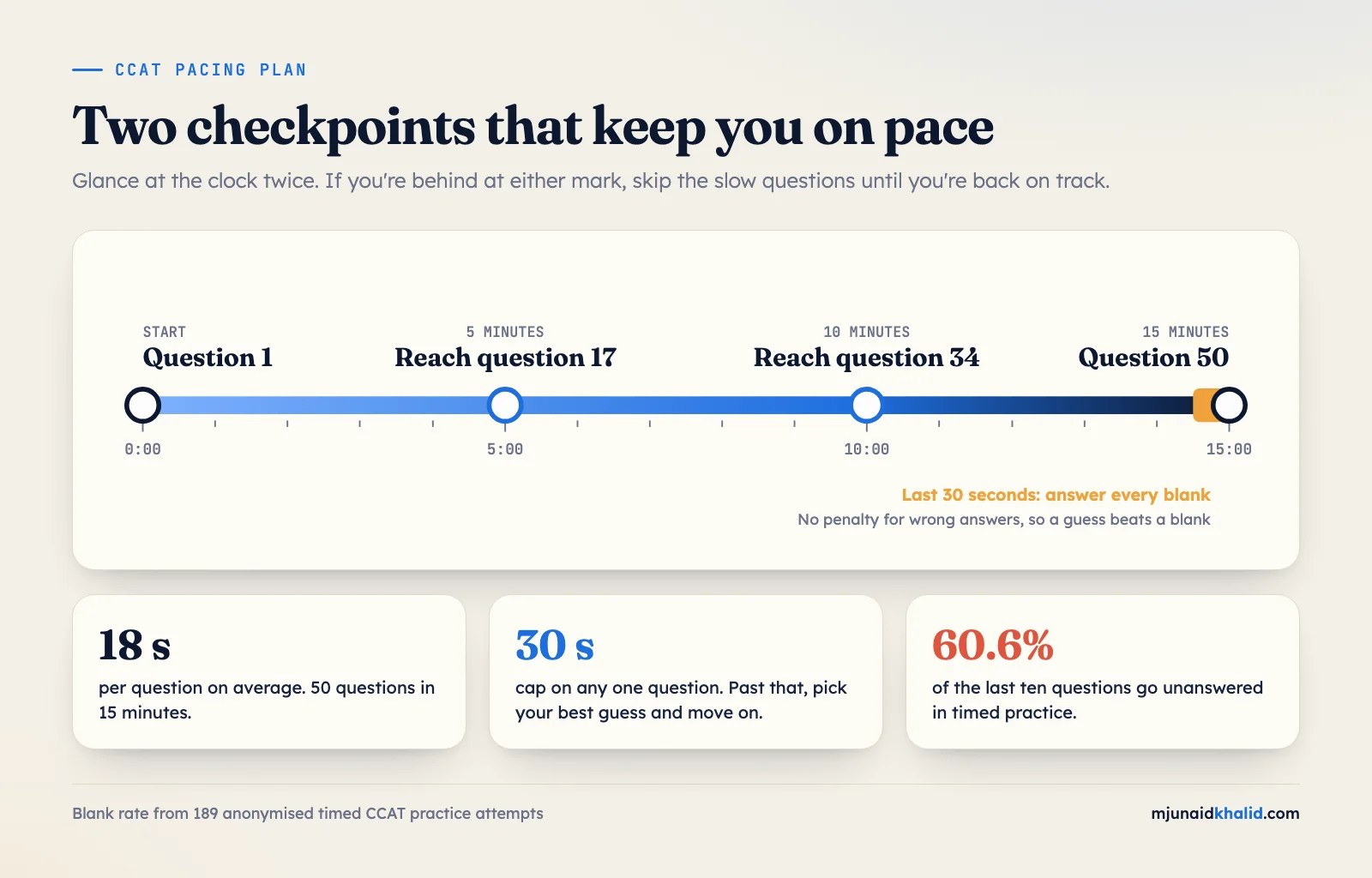
The research on unanswered questions shows where the rest went: 20.6% of CCAT questions were left blank, and 60.6% of the final fifth. Since the CCAT doesn’t penalise wrong answers, every one of those blanks was a free guess thrown away.
So here’s how I’d use any practice test on this list:
- Copy the real conditions. 15 minutes on a timer, one sitting, no pausing, a pen and scrap paper, no calculator. A practice test you pause halfway through tells you nothing about your pace.
- Use pace checkpoints. Aim to reach about question 17 by the 5-minute mark and question 34 by 10 minutes. If you’re behind, skip the slow ones until you’re back on track.
- Cap each question at about 30 seconds. PrepClubs’ time-per-question report found that answering the same question fast or slow changes accuracy by only about 3 points, while the median attempt wastes enough time on long answers to cover about 7 more questions.
- Guess every blank before time runs out. In the last 20 to 30 seconds, answer everything left. One in five odds on each beats zero.
- Review by time, not just by mistakes. After each test, find the question type that took longest. That’s what to drill before your next full run.
- Do four or five full runs. That’s roughly what I did before my first real sitting, and it was enough.
A few small things that help on the day: do 5 minutes of quick mental arithmetic beforehand to warm up, close every other tab and notification, and remember that the last ten questions are harder by design, so a rough patch near the end is normal.
If you want to go deeper on timing and preparation, these are the guides I wrote on it:
- How to Prepare for the CCAT in 3 Days (Emergency Game Plan)
- How Many Questions Should You Answer on the CCAT?
- 10 Essential CCAT Time Management Strategies That Actually Work
- Help! My CCAT Test Is Tomorrow: An Emergency Preparation Guide
Frequently asked questions
Which free CCAT practice test is closest to the real thing?
JobTestPrep’s free simulation and the CCAT Tests practice test both copy the real format of 50 questions in 15 minutes. Criteria’s own sample questions are closest in style, because Criteria writes the real test, but they aren’t timed.
How many practice tests should I take before the CCAT?
Four or five full, timed tests is a realistic target, with a review of each one. That’s about what I did before my first sitting. More helps only if you review properly between them.
Is there a free CCAT practice test PDF?
Some sites offer PDFs, but I’d avoid them for anything except reading questions. The CCAT is taken on a screen against a clock, and a PDF can’t train either.
What score should I aim for on a practice test?
It depends on the role, but 31 or more puts you around the top 20% and 35 or more is strong for most professional jobs. My guide to what counts as a good CCAT score has the full percentile chart and targets by role.
Is the CCAT the same as the CCAT for kids?
No. The Canadian Cognitive Abilities Test, also shortened to CCAT, is a school test for children and has nothing to do with the Criteria test employers use. If a practice test talks about grade levels, it’s the wrong one.
Where this comes from
I sat the real CCAT three times to get through Crossover’s hiring process and scored 40 or more each time, with a best of 48 out of 50 at the 99th percentile. Before the first sitting I did about four to five online practice tests, which is why this list is ranked by how well each resource copies the real timer. More than 100 people have asked me on LinkedIn where to practise, and this is the list I send them. The data on blanks, pacing and practice scores comes from PrepClubs’ published research reports, linked above, so you can check every figure.