
On this page
CCAT Sample Questions (2026 Edition): Examples with Explanations to Help You
Prepare Smarter
If you’re preparing for the CCAT and want to know what types of questions to
expect — you’re in the right place. In this guide, we’ll walk through real
sample questions from each section of the CCAT — Verbal Reasoning,
Math/Logic, Spatial Reasoning, and Deductive Logic — using actual examples
from the test format. For each, you’ll get a breakdown of what’s being tested
and how to think through the problem. These are not just samples — they’re
your opportunity to build strategy, not just familiarity.
🗣️ Verbal Reasoning Sample Questions
Question Type #1: Word Comparison  “How many of the five items in the left-hand column are
exactly the same as the corresponding item in the right-hand column?”
What’s being tested: Attention to detail under time pressure. Even a
missing comma or space can throw off your answer. Strategy: Use your
finger or cursor to go row-by-row. Don’t scan — compare. Quickly mark
mismatches. Don’t waste more than 25 seconds.
Question Type #2: Fill-in-the-Blank 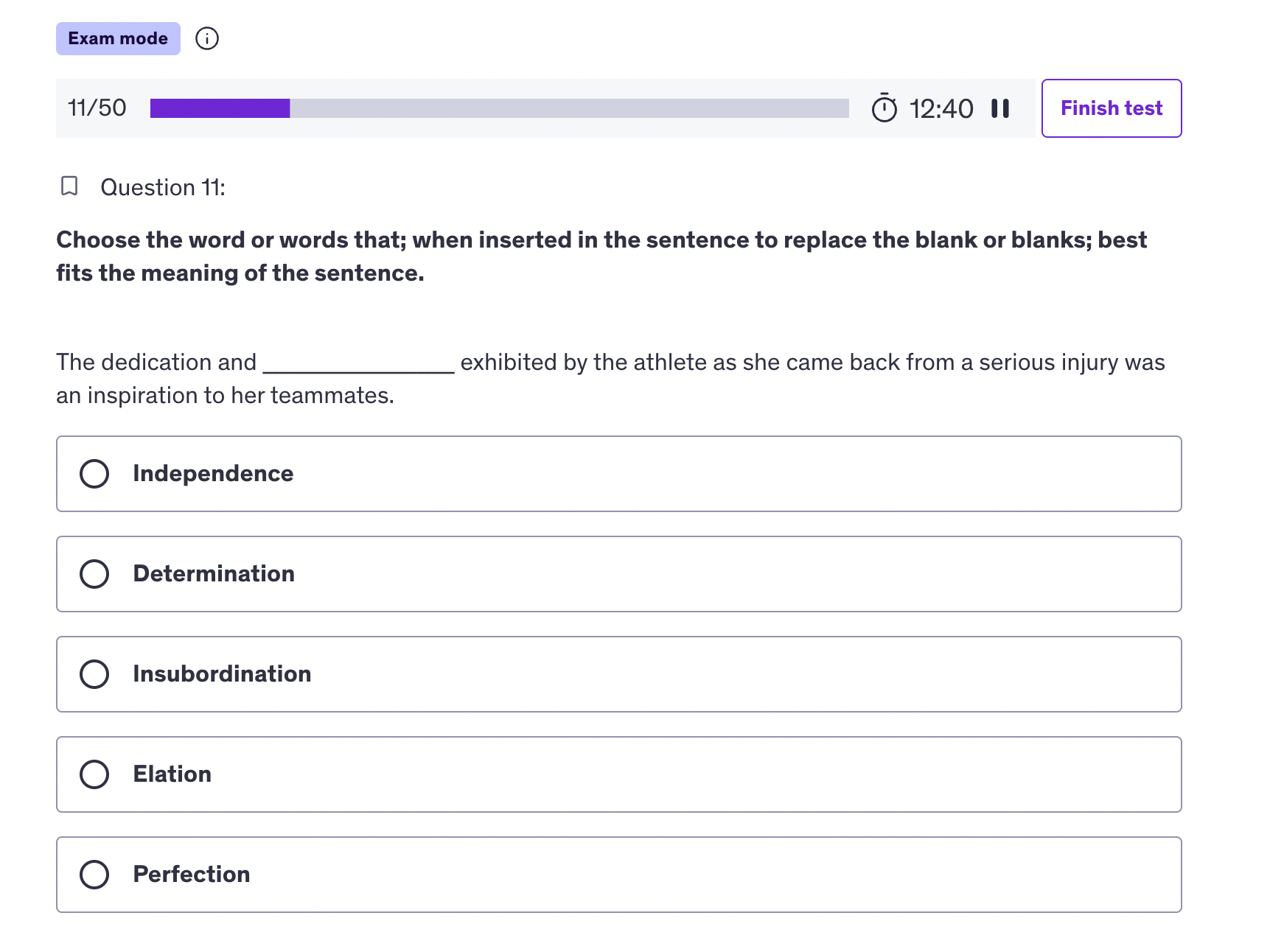
What’s being tested: Vocabulary + grammar structure + context clues.
Strategy: Eliminate grammatically incorrect or illogical options fast.
Then re-read with the most likely choice. Trust your instinct here.
Question Type #3: Analogies 
What’s being tested: Your ability to spot abstract word relationships.
Strategy: Create your own sentence linking the first pair. Then apply the
same logic to eliminate options.
➗ Math & Logical Reasoning Sample Questions
Question Type #1: Percentage Trick  “12 is 40% of what number?”
Strategy Trick: Add a zero to the first number (120), remove one from the
second (4), then divide: 120 ÷ 4 = 30. Done in 5 seconds. This kind of
question rewards people who know test tricks — not just math skills.
Question Type #2: Number Series 
What’s being tested: Pattern recognition — arithmetic, alternating,
geometric sequences. Strategy: Look for consistent gaps between numbers.
Check if it’s increasing/decreasing by a fixed value. Don’t overthink. If you
don’t see it in 20 seconds, guess and move.
🧩 Spatial Reasoning Sample Questions
Question Type: Pattern Completion  What’s being tested: Visual
logic. Can you spot what’s changing in the grid? Strategy: Mentally track
movement or rotation row-by-row or column-by-column. Eliminate answers that
clearly violate the rule. Don’t try to “solve” — just spot the most likely
one. You’ll also face harder ones like these: 
Tip: Don’t spend more than 25 seconds here unless you’re in the last 2
minutes with time to spare.
🧠 Deductive Reasoning (Logic Statements)
 Question Format: You’re given 3
statements. The first two are assumed true. You must judge if the third
logically follows. What’s being tested: Logic processing — ignoring
assumptions and judging based on limited evidence. Strategy: Think like a
computer. Don’t add outside information. If the third statement can’t be 100%
verified as true or false, answer “Uncertain.”
🎯 How to Prepare for the CCAT — Beyond Just Samples
Looking at examples is only half the battle. What really helps you improve is:
- Practicing under a 15-minute timer
- Learning shortcuts like the “percentage trick” and “two-pass method”
- Knowing which questions to skip and come back to
That’s why I built this: CCAT Practice Course on
Udemy — with full mock tests, video
explanations, and score calculators so you can simulate the real test and
boost your score fast.
🧠 Frequently Asked Questions
What types of questions are on the CCAT?
Verbal reasoning (analogies, vocabulary), math/logic (percentages, series), spatial reasoning (pattern completion), and deductive logic (true/false/uncertain).
Are CCAT sample questions available for free?
Yes, you can find samples online and on blogs like this one. But full-length practice tests with explanations are usually paid.
How many questions are on the CCAT?
50 questions in total. You get 15 minutes — that's roughly 18 seconds per question.
Can I finish all 50 questions?
Most candidates don't. A strong strategy is to aim for 30–40 well-answered questions instead of rushing through all 50.
Is it better to practice sample questions or take full mock tests?
Sample questions help build familiarity. But full mock tests help you build timing, endurance, and strategy — which is crucial to improving your real score.